
Google Block Breaker Blocks and Power-Ups: What the Game Really Ships
Last updated 6 min read
Some bricks in Google Block Breaker carry a small symbol, and those are the ones that change a run. This page is for players who have started a game, noticed a brick labeled TNT or a brick with nothing but a dashed outline, and want to know what is actually in there. Everything below comes from two places only: the game running on this page, and the names inside the code that game ships. Where neither source settles a question, this page says so instead of filling the gap.
Quick answer: Google Block Breaker's board mixes plain bricks with marked ones — a circle, a plus sign, diagonal stripes, scattered dots, a masonry pattern, a heart, the word TNT, and a dashed outline with no solid face. Broken bricks release coloured drops that fall toward your paddle. The build's own code names both helpful effects (multiball, laser, fireball, a longer paddle, an extra heart) and harmful ones (a shrinking paddle, acid and spores that hit the paddle), so catching every drop is not automatically the right move.
The marked bricks, as they appear on the board
A marked brick in Google Block Breaker is a brick with a small symbol printed on its face — TNT, a heart, a plus sign, a circle, stripes, dots, a masonry pattern, or a dashed outline. Marked bricks do something beyond vanishing when hit; unmarked bricks do not.
Start a run and the opening board is four rows of seven bricks in blue, red, yellow and green. Most of them are blank. A handful carry a symbol printed on the face, and those symbols are the game's only visual warning that a brick will do something other than disappear.
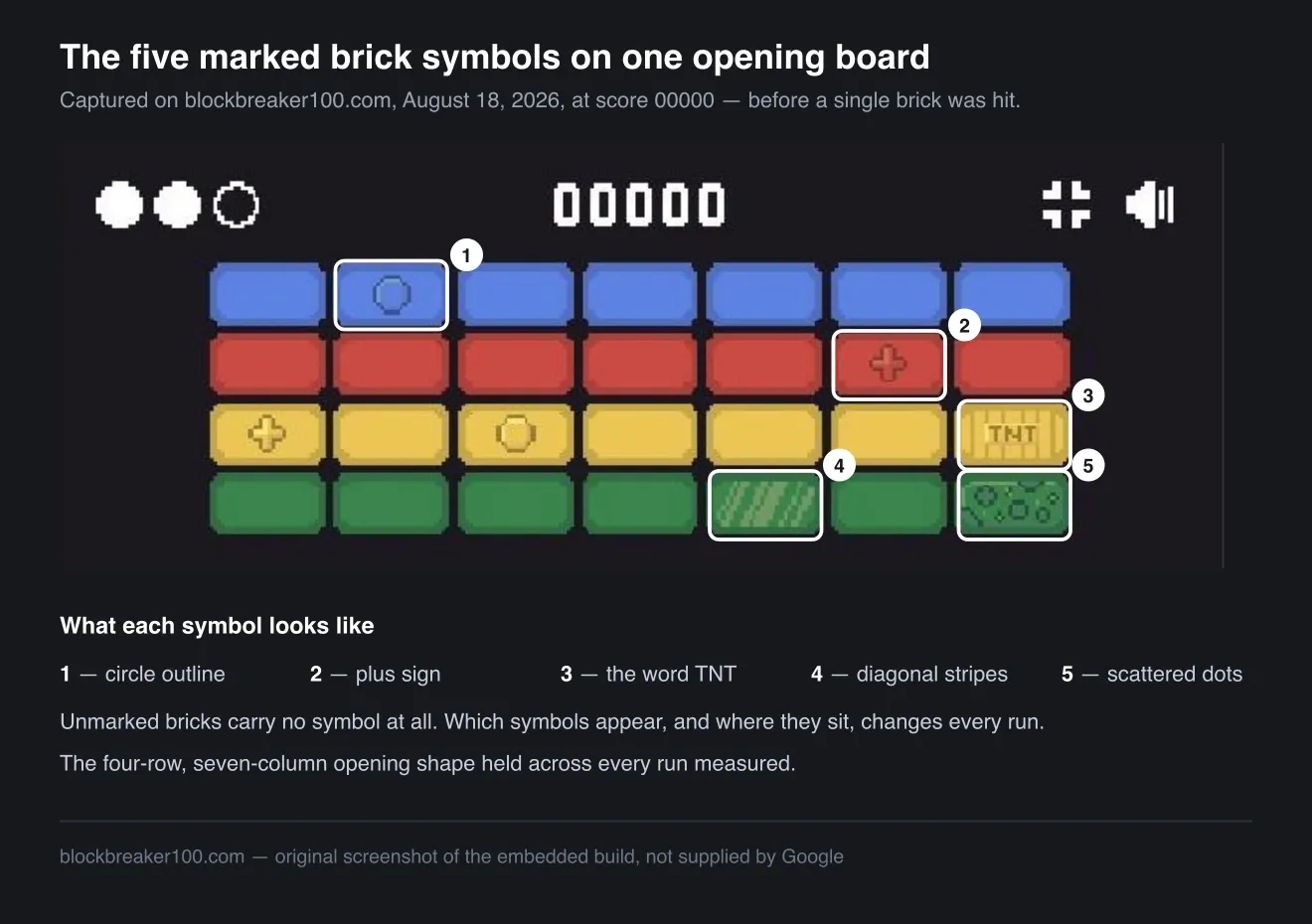
Across the runs measured for this page on August 18, 2026, these are the marks that appeared:
| Symbol on the brick | What it looks like |
|---|---|
| TNT | The letters TNT printed on the brick face |
| Heart | A small heart outline |
| Plus sign | A thick cross |
| Circle | A single circle or hexagon outline |
| Diagonal stripes | Two or three slashes across the face |
| Scattered dots | Small dots spread over the face, like spores |
| Masonry pattern | Drawn as stacked bricks rather than one flat slab |
| Dashed outline | An empty cell with a dotted border and no solid colour |
Which symbols show up, and where, changes from run to run. The four-row, seven-column opening shape held every time; later boards in the same run were not always full rectangles.
What the game's own code names
The build serves its logic in m_game.js, and while that file is minified, its audio-event names are not. They are the closest thing to an official parts list this game has, because each one fires on a specific in-game event. Grouped by what they refer to:
| What it refers to | Names the build ships |
|---|---|
| TNT brick | TNT_BLOCK_HIT, TNT_BLOCK_EXPLODES |
| Ghost brick | GHOST_BLOCK_APPEARS |
| Heart brick | HEART_BLOCK_HIT, HEART_COLLECTED |
| Multiball brick | MULTIBALL_BLOCK_HIT |
| Mushroom brick | MUSHROOM_BLOCK_HIT, MUSHROOM_SPORE_HITS_PADDLE |
| Acid brick | ACID_BLOCK_HIT, ACID_HITS_PADDLE |
| Multi-hit brick | BRICK_BLOCK_FIRST_HIT, BRICK_BLOCK_SECOND_HIT, BRICK_RUBBLE_HITS_PADDLE |
| Coloured bricks | a _BLOCK_HIT, _MIRROR_BLOCK_HIT and _POWERUP_BLOCK_HIT for each of blue, red, yellow, green |
| Paddle size | PADDLE_ELONGATES, PADDLE_SHRINKS |
| Laser | LASER_ENABLED, LASER_SHOOTS, LASER_HITS_BLOCK, LASER_TIMEOUT |
| Fireball | FIREBALL_ENABLED, FIREBALL_LAUNCHED, FIREBALL_HITS_BLOCK, FIREBALL_TIMEOUT |
| Shield | SHIELD_RISES, SHIELD_LOWERS |
| Other effects | LEVITATION_ENABLED, TARGETING_ENABLED, BLOCK_TARGETED, GRAVITY_BALL, LOOPING_BALL, WAVE_BALL, HEART_OR_POWERUP_DROP |
Two things follow from that list, and both matter more than any tip.
First, the game has effects that hurt you. PADDLE_SHRINKS, ACID_HITS_PADDLE and MUSHROOM_SPORE_HITS_PADDLE are not upgrades. A game whose drops are all beneficial does not need a sound for its paddle getting smaller.
Second, an inventory of names is not a description of behaviour. TARGETING_ENABLED tells you targeting exists; it does not tell you what it targets or for how long. This page treats the names as proof the mechanic ships, and nothing more.
What we measured in play
The observations below come from six runs played end to end on this page's embed on August 18, 2026, in desktop Chrome on macOS, with the board sampled frame by frame rather than eyeballed.
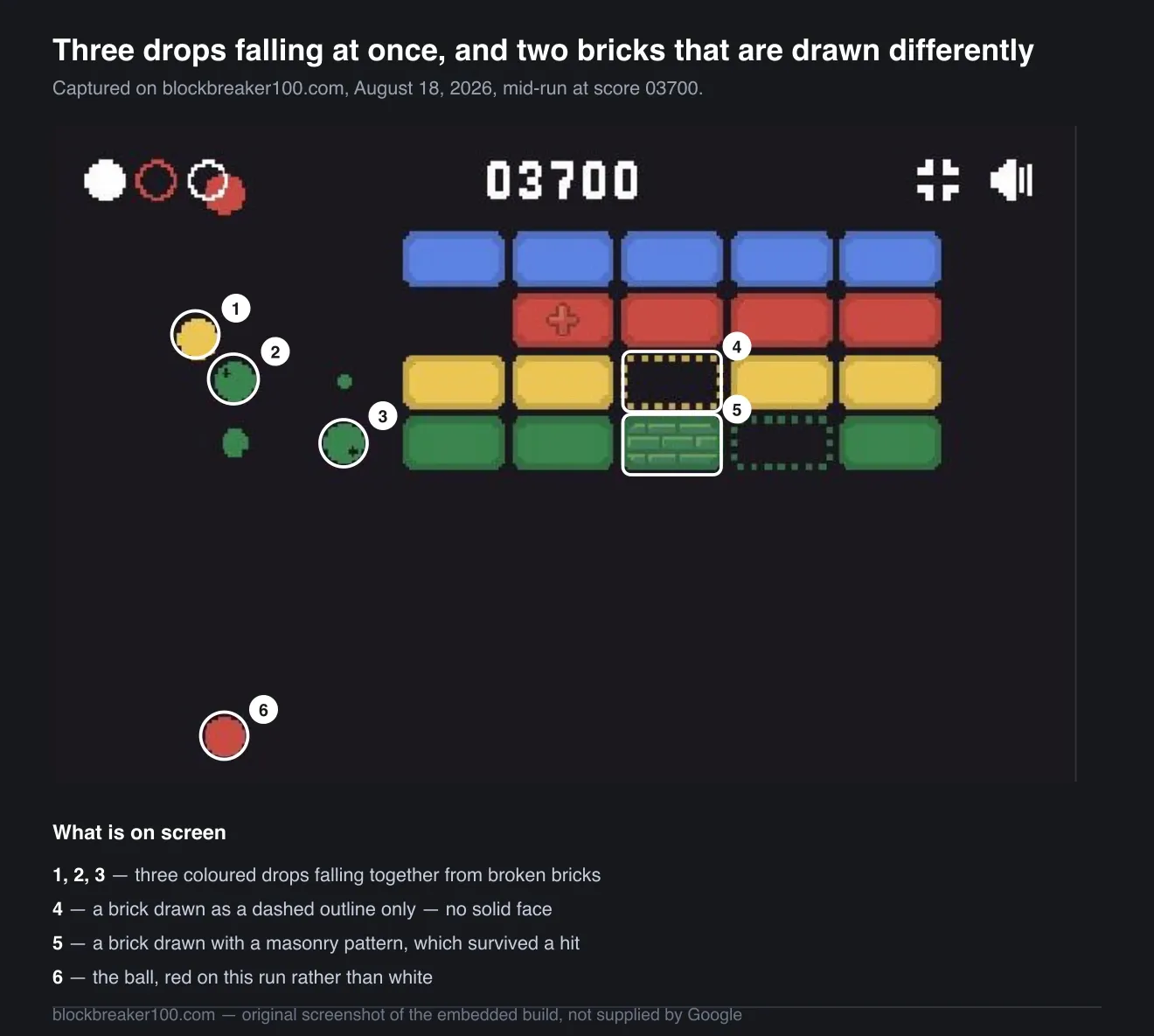
- Drops are coloured circles that fall toward the paddle. Blue, green and yellow ones all appeared, and three fell at the same time in the run above. They fall from broken bricks, not from thin air.
- Multiball is real and it is large. In one run a single ball became five balls at once, measured by counting distinct ball blobs in consecutive frames.
- The ball is not always white. One run played out with a red ball for several minutes. The build carries separate bounce sounds for white, red, blue, green and yellow balls, so ball colour is a state the game tracks rather than decoration.
- Some bricks survive a hit. The masonry-patterned brick stayed on the board after contact, matching the build's
BRICK_BLOCK_FIRST_HIT/BRICK_BLOCK_SECOND_HITpair. - Bricks can disappear in a group. In one frame-by-frame sample, four adjacent bricks spread across three different rows vanished inside the same 120-millisecond window, with 16 bricks still on the board. A single ball cannot touch four bricks on three rows in that time. That is what an area explosion looks like from the outside, and the build has a sound named
TNT_BLOCK_EXPLODES. Multiball was also in play during that run, so treat this as strong evidence of a group clear rather than a controlled demonstration of TNT specifically. - Every ordinary brick we tracked was worth 50 points. The score moved 00000 → 00050 → 00100 as the first two bricks broke, and later steps moved in multiples of 50. We did not find a brick worth a different amount, but we also did not test every symbol, so this page publishes no per-colour points table.
- Runs end after three balls. Three dots sit in the top-left corner and empty out as balls are lost. Game Over shows SCORE and HIGH, and the HIGH figure persisted between runs in the same session.
- One thing we could not explain. In a single frame out of six runs, several short white bars appeared near the bottom of the play area alongside the paddle, and they were gone by the next capture. We could not reproduce it on demand, and we are not going to tell you what it was. The build names
SHIELD_RISESandSHIELD_LOWERS, which would fit a temporary barrier near the floor, but fitting is not the same as knowing.
Where the popular guides get this wrong
The two most-cited Google Block Breaker reference pages both state that the game has no chain reactions and only beneficial power-ups. The build contradicts both claims by name. Here are the quotes, still live as of August 18, 2026, and what the game ships against each.
Claim: "There are no puzzle mechanics, no chain reactions, and no random effects. Every block behaves predictably." The build ships a sound named TNT_BLOCK_EXPLODES and another named GHOST_BLOCK_APPEARS, and we measured four bricks across three rows clearing inside 120 milliseconds. An exploding brick is a chain reaction; a brick that appears mid-run is not fully predictable.
Claim: "Power-ups in Google Block Breaker are entirely beneficial." The same build names PADDLE_SHRINKS, ACID_HITS_PADDLE and MUSHROOM_SPORE_HITS_PADDLE. Those are not benefits, and a page that tells you to catch everything is giving advice the code does not support.
The same pages also organise their block lists around silver, gold and indestructible bricks. Nothing in this build is drawn or named that way. The bricks it actually draws are the eight marked types in the table above.
One caveat this page holds itself to: these observations describe the build embedded here, a rehost of the Search easter egg that Android Central reported in January 2025. We have not diffed it against whatever Google serves inside Search today, so we do not claim the two are byte-identical.
What we still cannot tell you
- How many levels there are. The board changes when you clear it, and nothing on screen counts levels or shows a total.
- What each effect does precisely. We can prove
LEVITATION_ENABLEDandTARGETING_ENABLEDexist. We have not isolated either one in play, so this page does not describe them. - Whether brick colour changes its score. Every brick we tracked paid 50 points. That is not the same as proving colour is irrelevant.
If you want the wider context, the genre traces back to Atari's Breakout in 1976, and this build's own history is covered on our Block Breaker easter egg timeline. To try any of the above yourself, the game is playable on the Block Breaker homepage.